# Use Crazy Eights to ideate
> Learn how to run a Crazy Eights session — eight sketches in eight minutes — to generate a wide range of design ideas fast.
Source: https://uxspot.io/crazy-eights
What is Crazy Eights?
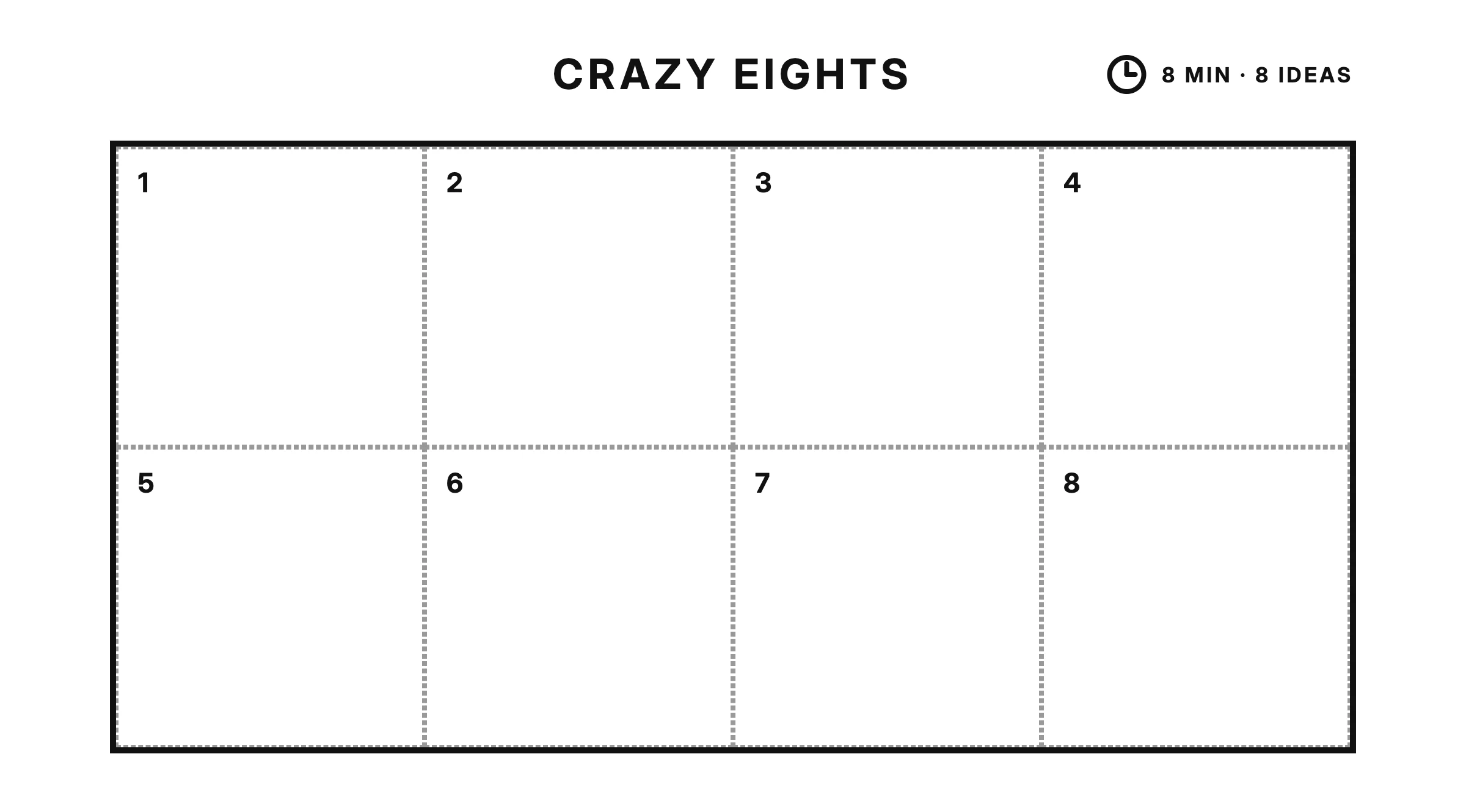
Crazy Eights is a rapid ideation exercise where each person folds a sheet of paper into eight panels and sketches eight different ideas in eight minutes — one idea per panel, one minute each.
The exercise comes from the design sprint tradition, but you don't need a full sprint to use it. Any time your team needs a wide spread of ideas for a screen, a flow, or a feature — say, eight different ways to present search filters in an e-commerce app — Crazy Eights gets you there in under ten minutes.
The point is not to produce eight polished designs. Crazy Eights is about quantity over quality: you flood the table with rough directions first, and only then decide which ones deserve refinement. Most panels will be throwaways. That's fine. You only need one or two sketches per person to spark something worth pursuing.
keywords
- #Ideation
- #Sketching
- #DesignSprint
Why speed works
Sixty seconds per idea sounds brutal, and that's exactly the point. When you have an hour to sketch, your inner critic has an hour to interfere. You second-guess, you polish, you talk yourself out of the weird idea before it ever hits the paper. The one-minute constraint silences the inner critic because there is simply no time to judge — only to draw.
Speed also forces variety. If you had unlimited time, you would keep iterating on your first idea. With a timer counting down and seven more panels waiting, you have to abandon each idea and reach for a different one. That reach is where the unexpected solutions live — the fourth, sixth, and eighth panels are often the interesting ones, because by then the obvious answers are used up.
There is a practical team benefit too. Because everyone sketches alone and simultaneously, quiet team members produce just as many ideas as the loudest voice in the room. Crazy Eights is one of the few ideation formats where seniority and confidence don't decide whose ideas get seen.
keywords
- #InnerCritic
- #TimeConstraint
- #QuantityOverQuality
How to run a session
You need paper, pens, a timer, and a clearly framed problem that everyone understands. Then follow these steps:
Fold the paper. Give each participant one sheet and have them fold it in half three times. Unfolded, it now has eight panels — one frame per idea.
Set the timer for eight minutes. Announce that each panel gets roughly one minute. Some facilitators call out every minute; others let people pace themselves. Either works, as long as the total stays at eight.
Sketch one idea per panel. Each panel should show a distinct idea, not a variation drawn slightly differently. If someone is designing a booking confirmation screen, panel one might be a full-screen summary, panel two a bottom sheet, panel three a calendar-first layout, and so on.
No erasing, no restarting. A messy sketch drawn in forty seconds beats a clean one that never got finished. If an idea stalls, move to the next panel. When the timer rings, pens down — even mid-line.
One reassurance worth saying out loud before you start: nobody needs to draw well — boxes for screens, arrows for flows, and stick figures for people are all the visual vocabulary Crazy Eights requires. A rectangle labeled "map" communicates the idea just as clearly as a rendered illustration would.
keywords
- #EightMinutes
- #OneIdeaPerPanel
- #NoErasing
Warm-ups for hesitant teams
If your team includes engineers, product managers, or stakeholders who insist they "can't draw," don't argue — warm them up instead. A two-minute drawing exercise before the real session lowers the stakes dramatically.
The 30-circles exercise. Hand out a sheet with thirty empty circles and give people three minutes to turn as many as possible into recognizable objects — a clock, a pizza, a wheel. It proves that fast, rough drawing is enough to communicate.
Draw your neighbor. Give pairs thirty seconds to sketch each other. The results are terrible and everyone laughs, which is exactly the point: once the worst drawing of the day is already on the table, nobody fears their sketches anymore.
Copy a UI pattern. Ask everyone to sketch a familiar screen — a login form, a checkout page — in one minute. This teaches the shorthand of boxes, lines for text, and circles for avatars that they'll reuse during the real exercise.
keywords
- #WarmUp
- #30Circles
- #SketchingConfidence
After the sketching
Eight minutes of sketching produces a pile of paper, and what you do next determines whether the exercise was worth it. There are three common ways to converge:
Share-outs. Each person gets two or three minutes to walk the group through their sheet, explaining the thinking behind each panel. This works well in small teams where discussion is productive and time allows.
Silent gallery review. Tape all sheets to a wall and have everyone browse in silence, like visitors in a museum. Because ideas are judged without knowing who drew them or hearing a persuasive pitch, a silent gallery review lets the sketches compete on merit instead of on the presenter's charisma.
Dot voting. Give each participant a handful of sticker dots to place on the individual panels — not whole sheets — they find most promising. The panels with the most dots become candidates for the next round: a more detailed sketch, a wireframe, or a prototype.
In practice, the strongest combination is silent review first, then dot voting, then a short discussion of only the top-voted panels. You get unbiased selection and focused conversation.
keywords
- #GalleryReview
- #DotVoting
- #ShareOut
When to use it — and when to skip it
Crazy Eights works best when the problem is well defined but the solution space is wide open. You know users abandon the checkout at the shipping step; you don't yet know what to do about it. That's the sweet spot: a clear question, many possible answers, and a team that has done enough research to sketch informed ideas rather than guesses.
Use Crazy Eights to diverge on a defined problem — never to define the problem itself.
Skip it when the problem is still fuzzy — sketching solutions to an unvalidated problem just produces eight confident answers to the wrong question. Skip it, too, when the decision is essentially constrained to one viable approach, such as a legally mandated consent flow, or when the work is deep system logic with no visual surface to sketch. And if the team just finished a round of ideation on the same question, another eight panels will yield repeats, not breakthroughs.
Takeaways
Crazy Eights trades polish for volume: eight rough ideas in eight minutes give you more raw material than an hour of careful sketching ever will.
Fold the paper, set the timer, keep one idea per panel, and don't erase. Warm up hesitant teammates with low-stakes drawing games, converge with a silent gallery review and dot voting, and reserve the exercise for well-defined problems with room to explore.