What is affinity mapping?
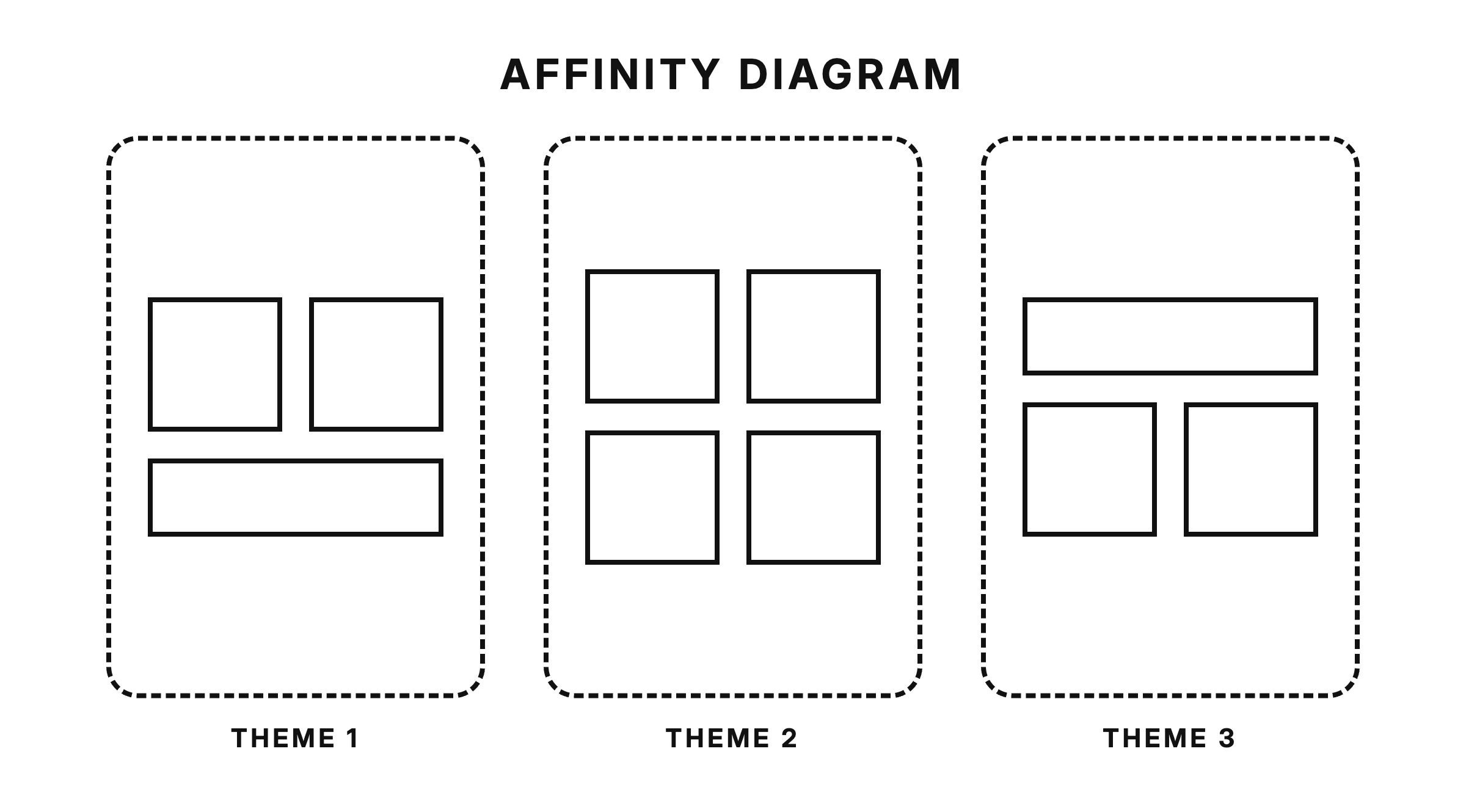
After a round of interviews you're left with pages of transcripts, and somewhere inside them are the insights you ran the research for. Affinity mapping is how you get them out. An affinity diagram groups individual observations into clusters of related ideas, so that themes emerge from the data instead of being imposed on it.
The method is deliberately simple: every observation, quote, or data point goes on its own note; notes that feel related get moved next to each other; each cluster gets a name once — and only once — a pattern is actually visible. The power is in the constraint. Because you sort observations before naming themes, the themes come from what participants actually said, not from what you expected to hear.
One observation per note, sort first, name last. Everything else about affinity mapping is detail.
Run an affinity mapping session
Harvest your notes. Go back through your interview transcripts and pull out every distinct observation: a verbatim quote, a behavior you saw, a frustration a participant mentioned. Write each one on its own sticky note — physical or digital — and tag it with the participant code, like P3, so you can trace any note back to its source.
Sort without talking. Spread the notes out and start grouping the ones that feel related. If you're mapping as a team, do the first pass silently — silent sorting stops the loudest voice in the room from deciding what the themes are before the data does. It's fine to move a note that someone else has already placed; notes should keep moving until the groups feel stable.
Name the clusters. Once the groups settle, give each one a short, descriptive label — a theme. Aim for labels that summarize the observations underneath, like "Users don't trust the payment step," rather than vague buckets like "Checkout stuff." A good test: if you read only the label, you should still learn something true about your users.
Handle the leftovers honestly. A few notes won't fit anywhere. Resist the urge to force them into a group — park them to one side. An outlier can turn out to be the first signal of something your next study should chase.
-
keywords
- #Observations
- #SilentSort
- #Themes
- #Outliers
From clusters to insights
A named cluster is a theme, not yet an insight. The last step is to ask, for each theme, what it means for the design: what need, obstacle, or motivation does this group of observations reveal? An insight states what you learned and why it matters — "Participants abandon the form because they can't tell which fields are optional" — in a sentence a teammate could act on.
These insights feed everything that follows in the process: they become the raw material for empathy maps, the evidence behind pain points, and the "because" clause of your problem statement. And the method returns later, too — the same clustering pass turns usability-test observations into findings when you synthesize test results.