From findings to ideas
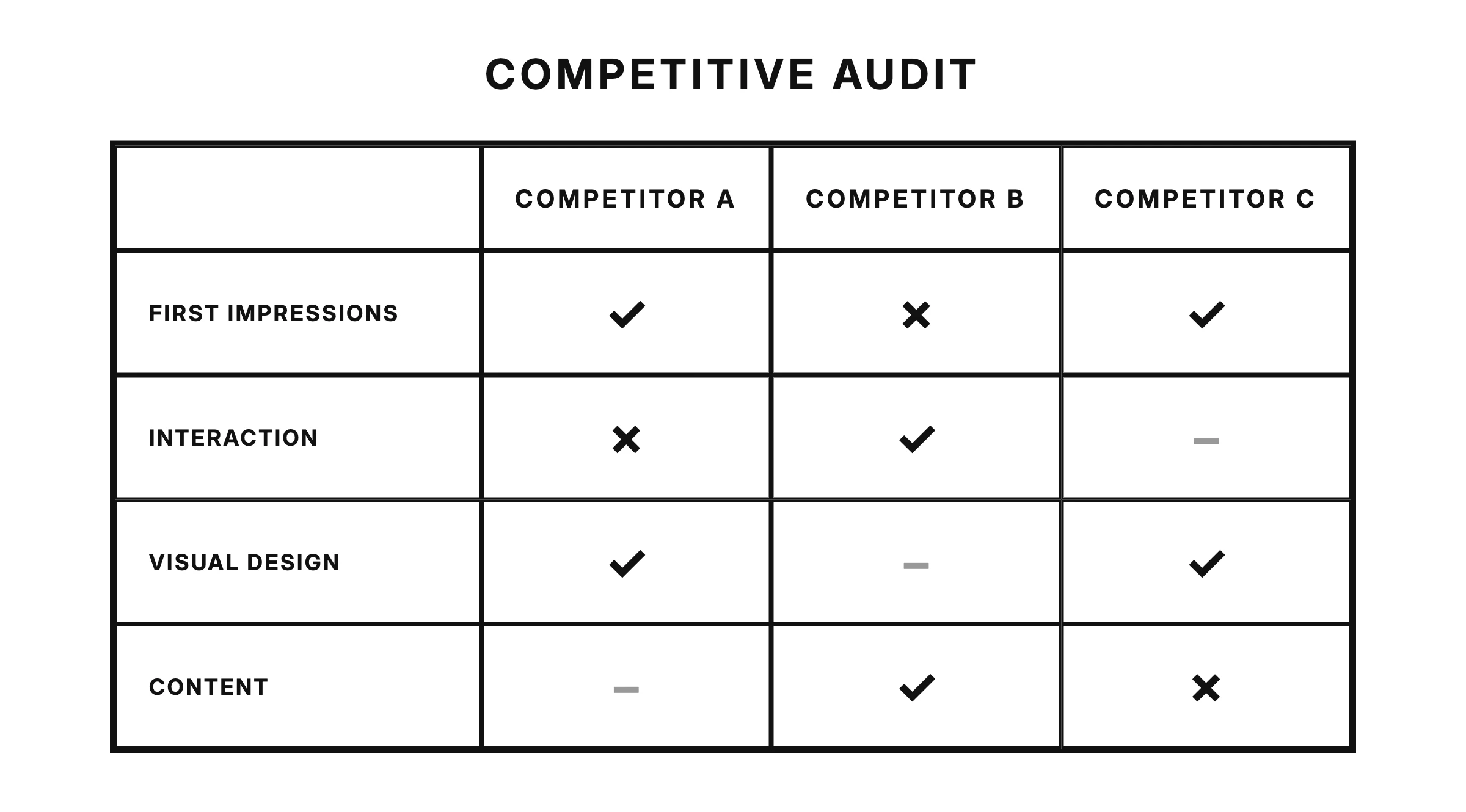
A competitive audit only pays off when its findings are translated into prompts that fuel your ideation sessions.
After you finish a competitive audit, you're left with a spreadsheet full of observations: what your competitors do well, where they fall short, and how their experiences compare to yours. That spreadsheet is not the end of the process. It's raw material. The real value of a competitive audit appears when you convert each finding into a question your team can ideate around.
The simplest way to do this is to rewrite findings as "How might we" prompts. A finding like "Competitor A's checkout requires account creation" becomes "How might we let users complete a purchase without creating an account?" A finding is a statement about the past; a prompt is an invitation to generate futures.
Go through your audit and turn every meaningful observation, positive or negative, into a prompt like this. Bring that list to your ideation session instead of the raw spreadsheet. Prompts give your team something to react to, while spreadsheets tend to make people compare features rather than imagine solutions.
-
keywords
- #AuditFindings
- #HowMightWe
- #IdeationPrompts
Gaps are opportunities
When you line up several competitors side by side, patterns emerge. Sometimes everyone solves a problem the same way. Sometimes nobody solves it at all. A gap that every competitor shares is an opportunity for your product to differentiate itself.
Look for three kinds of gaps in your audit:
Missing features. A need that users clearly have, but no competitor addresses. For example, no hotel booking app in your audit lets travelers filter rooms by accessibility features.
Weak executions. Everyone offers the feature, but every version of it is clumsy. If all your competitors bury order tracking three screens deep, a one-tap tracking experience becomes a genuine advantage.
Ignored audiences. Whole user groups that competitors overlook, such as first-time users, older adults, or people on slow connections. Serving them well can open a market segment your competitors don't even see.
Gaps make excellent ideation prompts because they come with built-in motivation: you already know the market hasn't answered them. Differentiation rarely comes from doing the same thing slightly better; it comes from answering a question competitors haven't asked.
-
keywords
- #Gaps
- #Differentiation
- #MissingFeatures
- #IgnoredAudiences
Inspiration, not imitation
Learn from what competitors do well, but treat their solutions as evidence of a need, never as a blueprint to copy.
It's tempting to look at a competitor's strength and simply rebuild it. Their onboarding is smooth, so you recreate it screen by screen. This almost always fails, and it's worth understanding why. A competitor's solution was designed for their users, their business model, and their technical constraints, none of which are yours.
A ride-sharing app can hide pricing details behind a single fare estimate because its users take short, low-stakes trips. Copy that pattern into a long-distance travel product, where a booking costs hundreds, and you create anxiety instead of simplicity. The pattern didn't fail; the context changed.
Copying also puts a ceiling on your product. If you imitate, the best possible outcome is a slightly delayed version of what already exists. Users have no reason to switch to a copy, and you inherit the original's flaws without understanding the reasoning behind its choices.
Instead, when a competitor does something well, ask what user need their solution serves. That underlying need is the insight worth keeping. Borrow the problem a competitor solved, then design your own answer to it based on your users and your constraints. That's the difference between inspiration and imitation.
-
keywords
- #Inspiration
- #Imitation
- #Context
- #UserNeeds
A walk-through example
Imagine you're designing a food-delivery app and you've audited four established competitors. Here's how the findings might travel from spreadsheet to ideation.
Finding: All four apps let users mark themselves as vegetarian, but none handle allergies or combined restrictions well. A user who is gluten-free and dairy-free has to read every ingredient list manually, dish by dish.
Gap identified: Dietary restrictions are treated as a single-choice label everywhere, even though real diets are layered and personal. This is a weak execution shared by the entire market.
Ideation prompt: "How might we help users with multiple dietary restrictions find safe meals without reading every ingredient list?"
Notice what the prompt does not say. It doesn't mention filters, badges, or profiles, which are the solutions competitors already use. It states the user's goal and the friction in their way, and leaves the solution space wide open. In the session, ideas might range from a dietary profile that greys out unsafe dishes, to restaurant-verified allergen tags, to a "safe for you" browsing mode.
A good prompt captures the unmet need from your audit while deliberately leaving out the solutions your competitors chose. That keeps your team ideating forward instead of remixing what's already on the market.
-
keywords
- #FoodDelivery
- #DietaryRestrictions
- #PromptWriting
Combine with your research
Audit insights tell you what the market offers. They don't tell you what your users need. Before ideating, cross-check your audit findings against your own user research: interviews, personas, and pain points you've already documented.
This matters because a gap in the market is only an opportunity if your users actually feel it. Perhaps no competitor offers scheduled group orders, but if none of your interview participants ever mentioned ordering as a group, that gap may simply be a need nobody has. Conversely, if a pain point shows up in both your research and your audit, you've found a validated opportunity.
Prioritize the prompts where a competitor gap and a documented user pain point overlap; that's where ideation effort pays off fastest. A simple way to do this is to lay your prompts next to your personas and ask, for each one, "which of our users struggles with this, and how do we know?" Prompts with a clear answer go to the top of the pile. Prompts without one go back into the research backlog until you have evidence either way.
-
keywords
- #UserResearch
- #PainPoints
- #Validation
- #Prioritization
Takeaways
A competitive audit becomes useful the moment you turn its findings into open-ended prompts your team can ideate around.
Hunt for gaps the whole market shares, because those are your chances to differentiate. Treat competitors' strengths as proof of a user need, not as designs to copy, since their solutions were built for their context, not yours. And before you ideate, filter every prompt through your own user research so you spend your creative energy on problems your users genuinely have.