Know your audience
A competitive audit only creates value when the people in the room understand it, believe it, and act on it. That starts with knowing who those people are.
Before you build a single slide, ask yourself who will be sitting in front of you. Designers and stakeholders care about the same audit for completely different reasons, and your presentation has to serve both.
Designers want depth. They want to see how a competitor's checkout flow handles errors, why one onboarding pattern feels smoother than another, and which interaction details are worth borrowing or avoiding. For them, screenshots, flows, and specifics are the interesting part.
Stakeholders such as product managers, executives, or clients want altitude. They want to know where the product stands in the market, what gaps competitors are exploiting, and what you propose to do about it. If you walk them through button styles for twenty minutes, you will lose them.
When your audience is mixed, lead with the business story and keep the design detail in an appendix that anyone can zoom into afterwards.
-
keywords
- #Audience
- #Stakeholders
- #Designers
- #Depth
Structure your presentation
A predictable structure is not boring; it's respectful. It tells your audience where you're going, so they can focus on the content instead of guessing what comes next.
Start with the goals. Remind everyone why the audit was done, for example: "We wanted to understand why competitors convert first-time visitors better than we do." One or two sentences are enough, but they frame everything that follows.
Then share the key findings. Pick the three to five discoveries that matter most. For each one, say what you found, show one piece of evidence, and explain why it matters for your product.
End with recommendations. Findings without a "so what" leave the room flat. Close with what you believe the team should do next, in priority order.
Goals, findings, recommendations — in that order — is the simplest structure that turns research into a decision. If someone leaves after ten minutes, they should still have heard the most important part.
-
keywords
- #Goals
- #KeyFindings
- #Recommendations
- #Structure
Present insights, not raw data
An insight is a conclusion drawn from your data that changes how the team thinks or what it does next. Data is what you collected; insight is what it means.
Your audit probably lives in a large spreadsheet of feature matrices, pricing tiers, and usability notes. That spreadsheet is your working document, not your presentation. Nobody in the room will read the whole spreadsheet, and asking them to is asking them to do your job.
Compare these two statements. Raw data: "Competitors A and B offer guest checkout; Competitor C and our product require an account." Insight: "We are one of only two products in this space that force account creation before purchase, and it's likely costing us first-time buyers."
The second version does the synthesis for the audience: it names the pattern, states the risk, and points toward a decision. Aim for that level in every finding, and link the full spreadsheet at the end for anyone who wants to verify your work.
-
keywords
- #Insights
- #Synthesis
- #RawData
Visualize comparisons simply
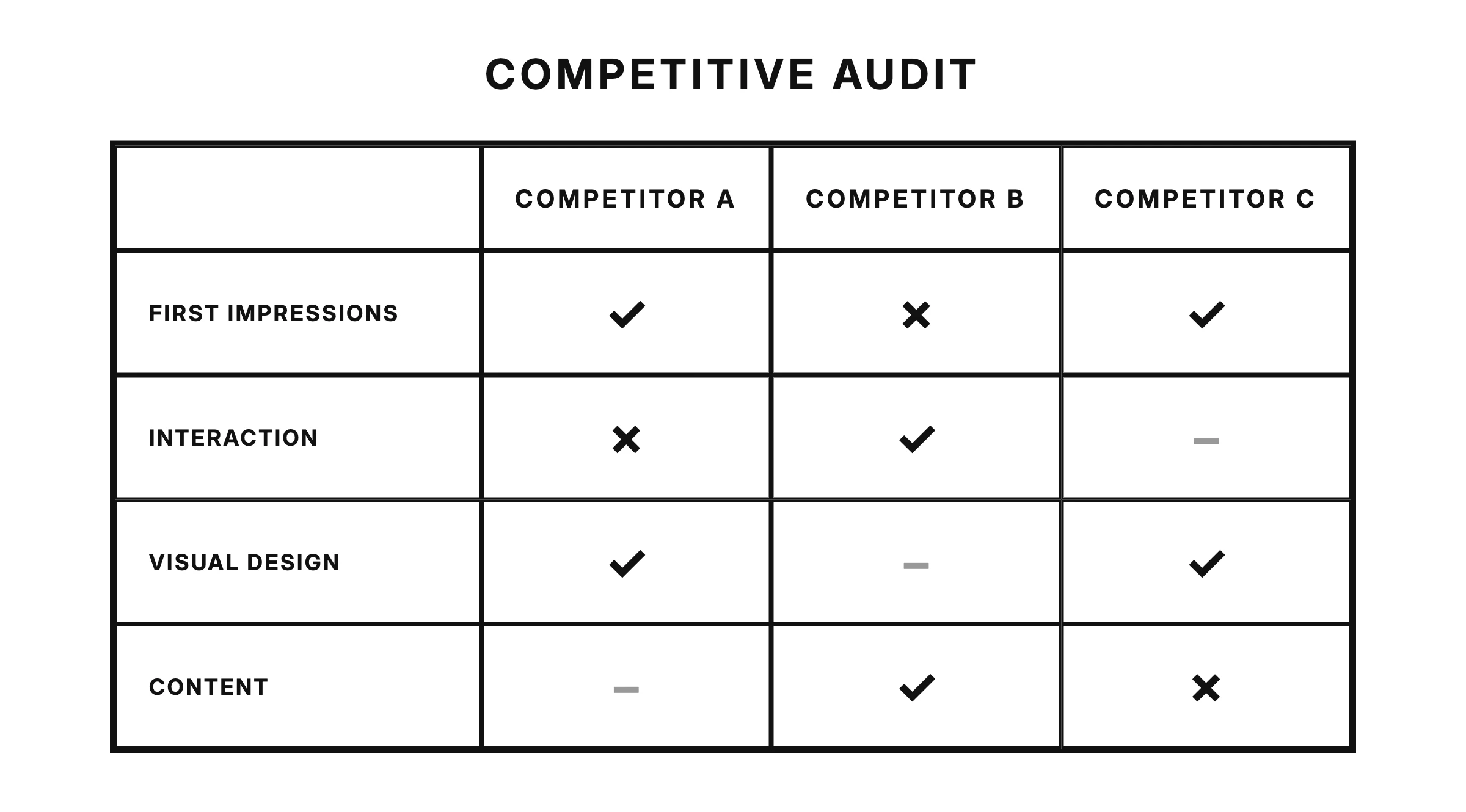
Comparison is the heart of a competitive audit, and comparisons are far easier to see than to read. Three simple formats cover almost every situation:
A comparison matrix with competitors as columns and criteria as rows, using simple yes/no or good/okay/poor ratings. It answers "who does what" at a glance.
A two-axis map that plots competitors on the two dimensions your audience cares about most, such as price versus feature depth. Empty space on the map often reveals an opportunity.
Side-by-side screenshots of the same moment in each product, like the first screen of onboarding. One annotated pair of screens can show a usability gap faster than a paragraph.
Every visual should make exactly one point, and that point should be readable in five seconds. If a chart needs a legend and a verbal walkthrough to make sense, split it into simpler pieces.
-
keywords
- #ComparisonMatrix
- #Visualization
- #Screenshots
- #Simplicity
Make recommendations actionable
A recommendation like "we should improve our onboarding" is a wish, not a recommendation. Nobody can pick it up on Monday morning. Actionable recommendations share three traits:
They are specific. "Add a guest checkout option and defer account creation until after the first purchase" tells the team exactly what to explore.
They are tied to your product's goals. Never recommend copying a competitor just because they do something. A competitor's feature only matters if adopting or countering it moves one of your own goals, such as conversion, retention, or trust. If your goal this quarter is reducing drop-off at checkout, your top recommendations should attack exactly that.
They are prioritized. Present a short ranked list rather than an unordered pile. "If we do only one thing, it should be this" is one of the most useful sentences in the whole presentation.
Stop short of prescribing the final design. Your job here is to point the team at the right problems with evidence, not to hand them finished solutions.
-
keywords
- #Actionable
- #ProductGoals
- #Prioritization
Handle questions and pushback
Pushback is not a sign that your presentation failed. It usually means people are engaged enough to test your thinking. A few habits will help you stay steady:
Anticipate the hard questions. Ask yourself what a skeptic would challenge: "Why these competitors?", "Isn't this sample too small?", "Didn't we try this before?". Prepare a short, honest answer for each.
Separate evidence from opinion. Be clear about which parts of your audit are observed facts and which are your interpretation. Defend your evidence firmly, but hold your interpretations loosely — being open to a better reading of the data builds more credibility than winning the argument.
Park what you can't answer. If a question goes beyond what the audit covered, say so, note it visibly, and follow up later. A confident "I don't know yet, but I'll find out" beats an improvised guess every time.
End with a decision. Before the meeting closes, ask for the next step: which recommendation gets explored first, and who owns it. Without that, even a great presentation evaporates by the next sprint.
-
keywords
- #Pushback
- #Evidence
- #Questions
- #NextSteps
Takeaways
A competitive audit is judged by the decisions it produces, not by the amount of research behind it.
Tailor the depth to your audience, move from goals to findings to recommendations, and present insights rather than raw data. Keep every visual simple, tie every recommendation to your product's goals, and treat pushback as a chance to sharpen the work. Do that, and your audit becomes a starting point for action instead of a document nobody opens twice.